
-1.png?width=300&height=86&name=Axiom_Wordmark+Symbol_BlueRGB%20(1)-1.png "Axiom_Wordmark+Symbol_BlueRGB (1)-1")

For many organisations navigating the S4 Hana migration journey, the promise is compelling: a modern, cloud-first ERP that finally delivers real-time analytics, streamlined processes, and a platform built for the future of digital procurement.
The reality, when it comes to SAP S/4HANA catalog sourcing, is considerably more complex. This article covers what is genuinely not working, who it hurts, and what a real fix looks like - without the vendor spin.
The Honest History of Catalog Sourcing in SAP
SAP's catalog journey spans over three decades. It started in the 1990s with SAP MM under ECC: static internal material lists, adequate for standardised goods, but without real-time supplier integration or meaningful search. In the early 2000s, SAP SRM introduced hosted catalogs and punchouts. Progress, but at the cost of steep technical complexity and maintenance demands so high that SRM is now being retired in 2027.
Then came the Ariba acquisition in 2012 - what many in the market still refer to simply as Ariba Procurement. Cloud-based S2P, hosted catalogs, supplier-managed content via the Ariba Network. Genuine momentum, and genuine hope for an integrated procurement platform.
And then investment stalled. The result is that SAP S/4HANA catalog sourcing capabilities are once again falling behind best practice - not because SAP hasn't tried, but because the fundamental data architecture was never rebuilt from the ground up.
As Alistair Cane, Co-Founder of Axiom, puts it:
"The truth is that until the fundamental data architecture behind SAP's catalog management approach changes, business outcomes will remain lacklustre for clients regardless of how many new modules are developed and 'bolted on' to it."
What Each SAP Module Actually Delivers on Catalog Sourcing
Across every SAP management tool built for catalog sourcing, the pattern is consistent: fragmentation, governance burden, and a user experience that has fallen a long way behind what people expect from modern e-procurement systems.
- SAP ECC / MM - Basic internal catalogs. Manual maintenance, limited UX, minimal OCI punchout support.
- SAP S/4HANA (Fiori) - Enhanced UI with catalog support. Search limitations, inconsistent integration.
- SAP SRM - Hosted and punchout catalogs. Obsolete, complex, being retired 2027.
- Ariba Buying and Invoicing - Broader catalog capability. Complex to maintain, punchout issues, low adoption.
- SAP Business Network - Supplier-managed catalogs. Sync delays, content quality control issues.
- Ariba Central Procurement - Pulls catalogs from connected systems. Fragmented sources, harmonisation challenges.
Who Suffers, and What It Costs Them
SAP S/4HANA catalog sourcing is not a problem that stays in the IT department. It reaches every stakeholder in the procurement lifecycle.
Buyers and Requesters
Clunky interfaces, broken punchouts, and non-competitive pricing drive buyers away from approved routes. When the compliant path is harder than going off-contract, maverick buying follows. Every time.
Procurement Teams
High catalog maintenance workload, poor adoption, and limited spend management visibility pull teams away from strategic procurement management and strategic sourcing management - the work that actually creates value. Resources are consumed by administration rather than analysis, supplier management, or strategic sourcing initiatives.
Suppliers
Complex Ariba onboarding, poor feedback loops, and low catalog ROI reduce supplier motivation to keep content current. Without real supplier collaboration or dedicated supplier onboarding software behind it, data quality degrades. Buyers feel it.
IT Teams
Punchout integration issues and inconsistent UX across Fiori, Ariba, and SAP GUI generate constant support requests, high costs, and low stakeholder satisfaction.
Finance and Accounts Payable
Outdated catalog data creates invoice mismatches, approval bottlenecks, and 3-way match exceptions that slow payment cycles, distort spend management reporting, and skew procurement KPIs.
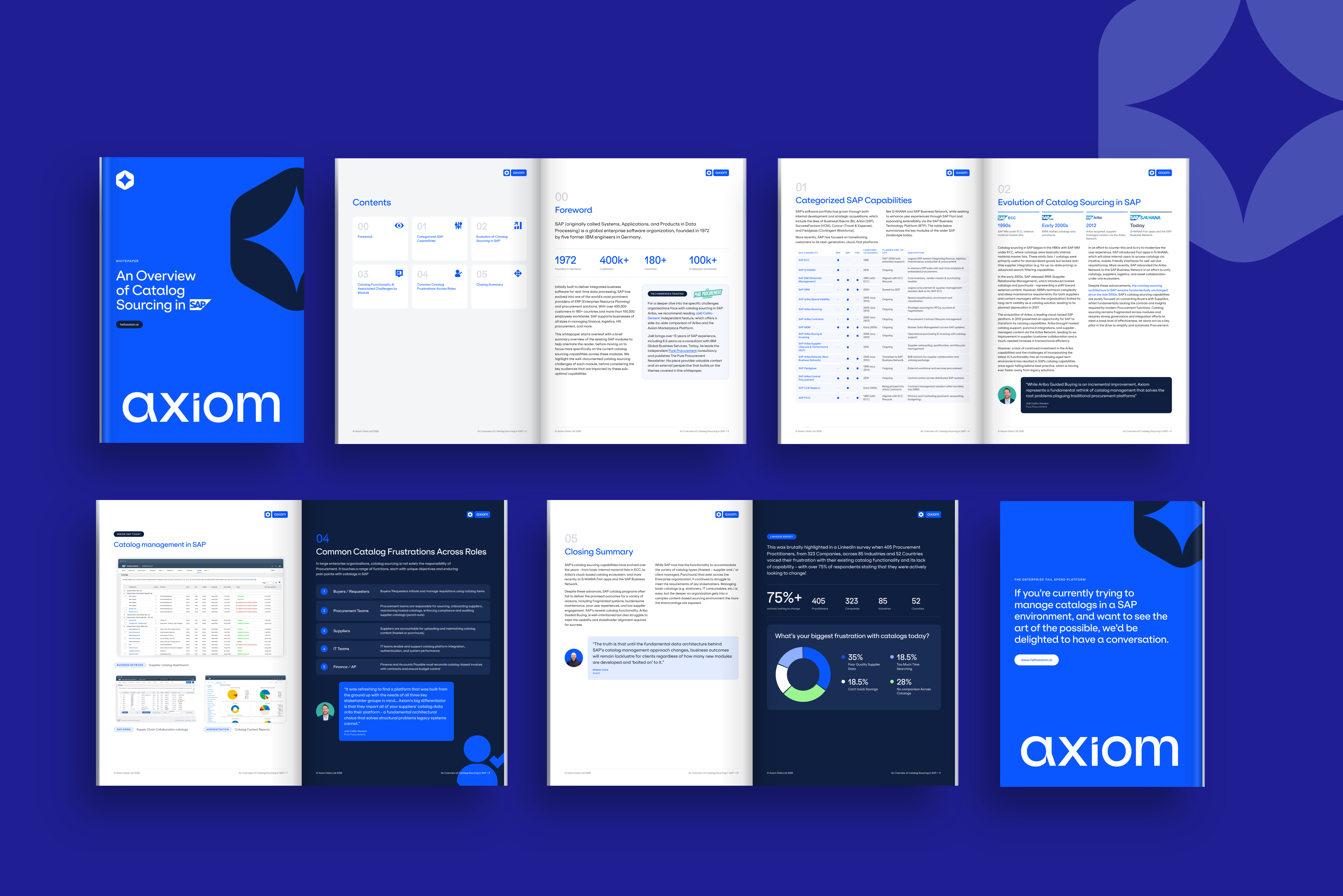
A LinkedIn survey of 405 procurement practitioners across 323 companies, 85 industries, and 52 countries confirmed the scale of dissatisfaction: over 75% were actively looking to change their catalog solution
Why Ariba Guided Buying Is Not the Answer
Ariba Guided Buying is the most prominent recent attempt to address SAP S/4HANA catalog sourcing challenges. It improves the user experience at the surface level, and it is well-intentioned.
But it is still built on the same fragmented architecture. It is an incremental improvement to a procurement platform that needs structural change, not cosmetic updates.Managing simple, low-risk indirect sourcing categories such as stationery, IT consumables, or MRO (maintenance repair operations) works adequately. The deeper an organisation goes into complex, content-rich categories, the faster the shortcomings appear.
Joël Collin-Demers, Consulting Principal at Pure Procurement with over 13 years of SAP experience, put it directly after an independent review of both platforms:
"While Ariba Guided Buying is an incremental improvement, Axiom represents a fundamental rethink of catalog management that solves the root problems plaguing traditional procurement platforms."
What Procurement Digitalisation Actually Requires Here
For organisations committed to genuine digital transformation procurement, the catalog layer is where the biggest gap exists between ambition and reality.
Whatever you call it - an e-procurement platform, an e-procurement system, or simply modern digital procurement tools - a real digital procurement solution does not patch the existing architecture. It rethinks it. That means:
- Unified catalog search across all suppliers, in one interface, with real-time pricing and live inventory visibility
- Clean, structured data returned to SAP every time, eliminating free text purchasing for any item in the library and protecting material master integrity
- Procurement analytics accessible directly within the platform - the kind of procurement intelligence platform capability that used to require a separate reporting project
- Supplier management made visible and actionable, with approved suppliers, pricing, and terms surfaced in a single view, backed by real supplier information management and supplier collaboration solutions rather than static spreadsheets
- Tail spend automation that reaches 90% automation across transactions - real procurement process automation, not as a target but as a delivered outcome
Axiom's MarketPlace and MarketMaterials are built on this architecture as a genuine supplier sourcing platform, delivered as a single procurement management platform rather than a fragmented, bolted-on procurement SaaS module. They integrate with SAP via OCI punchout, meaning your existing workflows and procurement solutions stay intact while the buying experience is fundamentally transformed.
The Bottom Line on SAP S/4HANA Catalog Sourcing in 2026
The S4 Hana migration is a strategic opportunity that procurement leaders - and the CPO tools they choose - should not waste on a catalog layer that underperforms. SAP is the right backbone for enterprise operations. But catalog sourcing demands a dedicated procurement platform designed for the purpose - not another bolt-on.
This isn't something generic tail spend management providers or tail spend management tools can patch from the outside, whether the category is stationery, IT consumables, or MRO procurement. Catalog sourcing sits at the tail end of spend that's hardest to control, and it has to be solved at the data layer inside the buying flow itself.
The organisations achieving 90% procurement automation, releasing their teams for strategic procurement and strategic sourcing work, and delivering a consumer-grade buying experience to thousands of users are not doing it through SAP alone. They are pairing SAP with a purpose-built digital procurement solution that solves the structural problem SAP has not yet solved itself.
If you are managing catalogs in a SAP S/4HANA or SAP Ariba environment and want to see what genuinely is possible, book a discovery call with the Axiom team.
.svg)